LDAP
Lightweight Directory Access Protocol (LDAP) is a protocol used to access and manage directory information, enabling centralized authentication and user management. By configuring LDAP with directory services you can streamline secure user authentication and access control in ToolJet.
Configure LDAP SSO
To set up LDAP as Single Sign-On (SSO) for ToolJet, follow these steps:
Role Required: Admin
-
Click on the settings icon (⚙️) on the bottom left of your dashboard.
-
Go to Workspace settings > Workspace login.
(Example URL:https://app.corp.com/nexus/workspace-settings/workspace-login)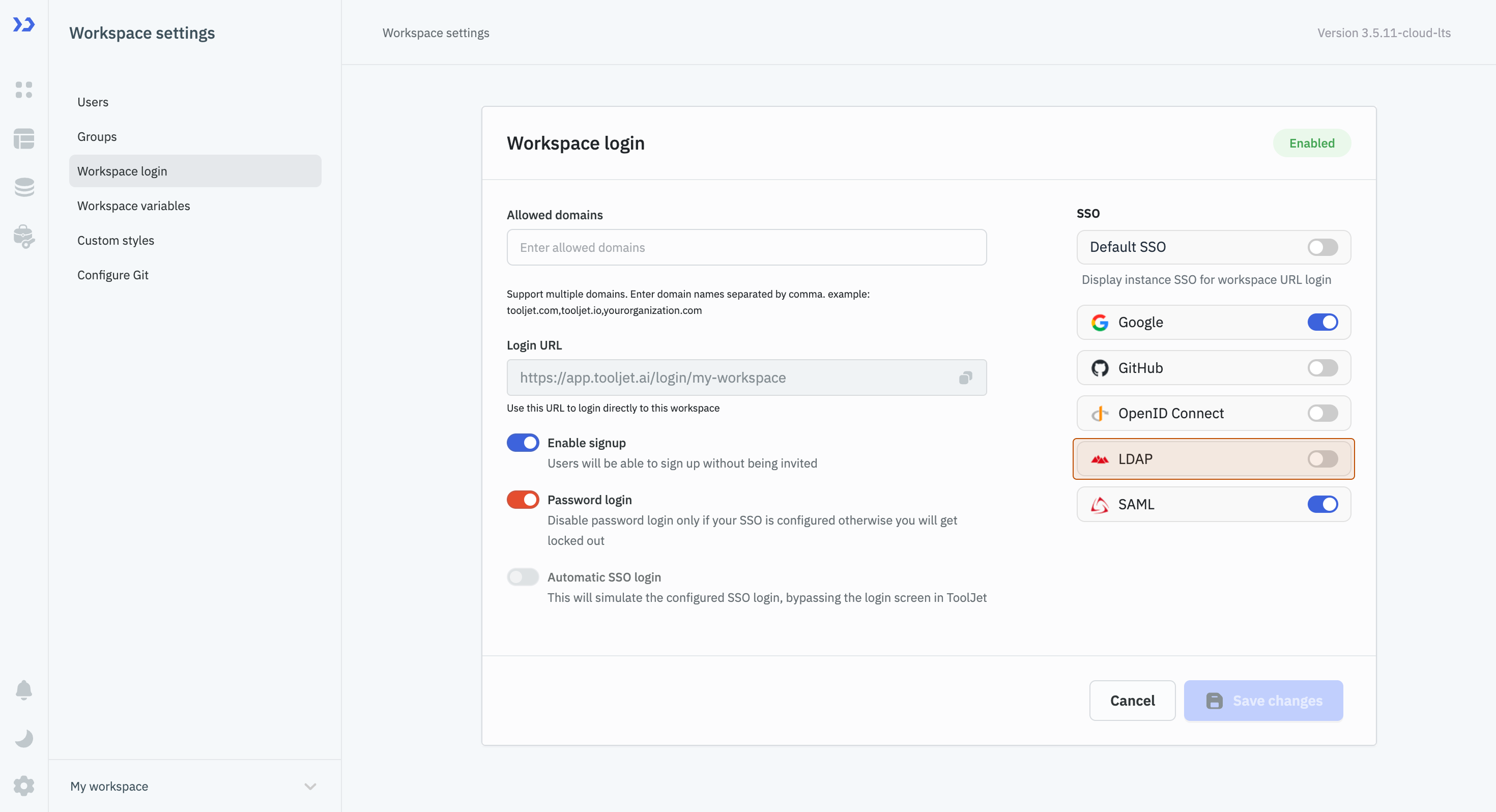
-
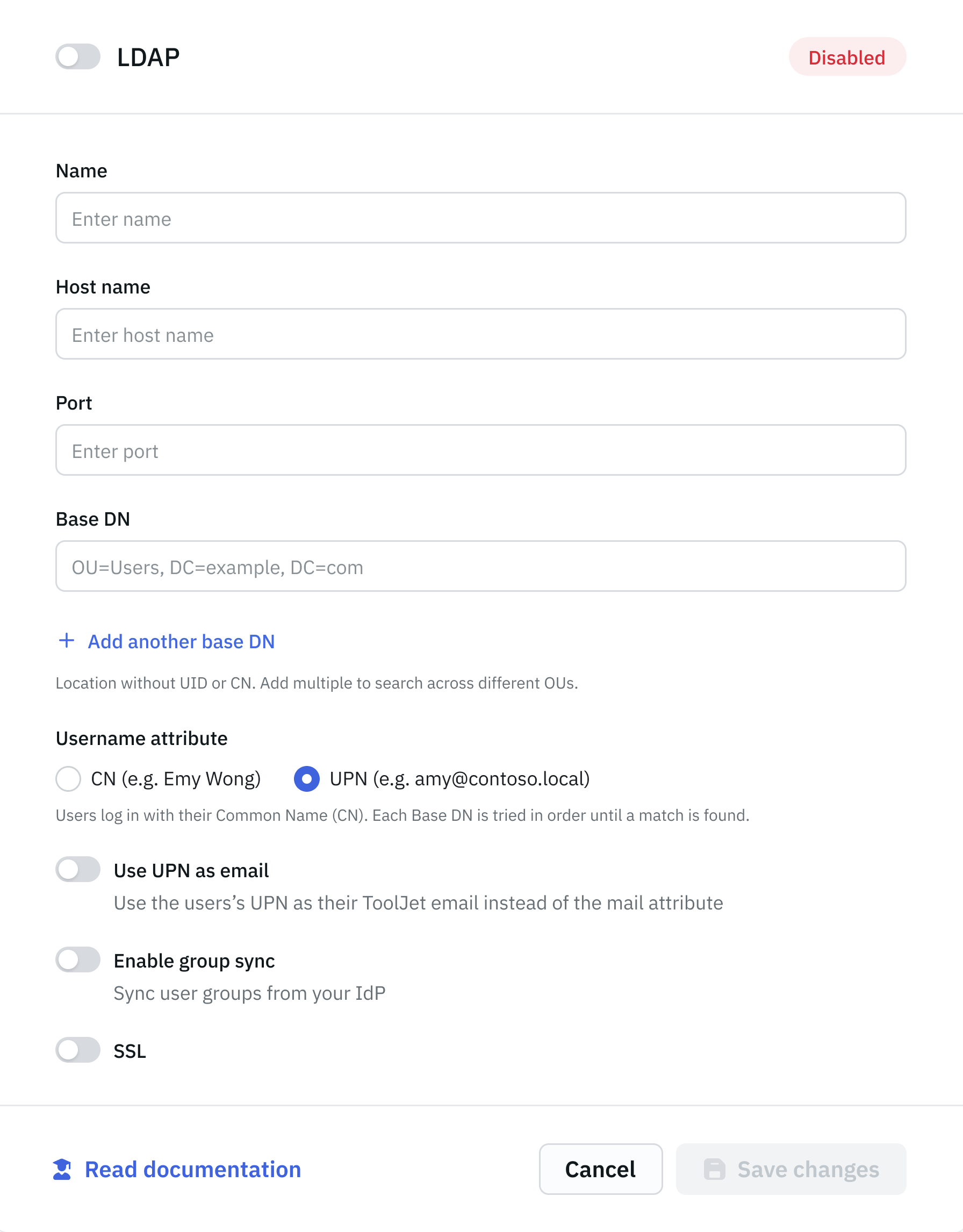
To enable LDAP, toggle the switch. Then, add the configuration:
- Name: Enter the name of the SSO.
- Host name: Provide the hostname or IP address of your LDAP server.
- Port: Enter the Port number of LDAP server.
- Base DN: Enter the distinguished name of the container that holds your users, for example
OU=Users,DC=example,DC=com. Specify the location without the UID or CN. Click + Add another Base DN to search across more than one Organizational Unit (OU). - Username attribute: Choose whether users sign in with their CN (for example,
Amy Wong) or their UPN (for example,[email protected]). The default is CN. - Use UPN as email: Available when the username attribute is set to UPN. Turn it on to use the user's UPN as their ToolJet email instead of the
mailattribute, provided the UPN is a valid email address. - Enable group sync: Syncs the user's groups from your directory on every login. Enabled by default.
- SSL: Toggle this option to enable the SSL. After enabling you can select the type of SSL: None or Certificates. If you choose Certificates, you'll need to provide the Client Key, Client Certificate, and Server Certificate.
-
After making the necessary configurations, click the Save Changes button located at the bottom.
-
Next, proceed to the Workspace login and copy the Login URL provided.
-
The Login URL obtained can be utilized for accessing the workspace. Please note that ToolJet supports LDAP login at the workspace level and not at the instance level. Thus, users will be logged in specifically to the chosen workspace.
-
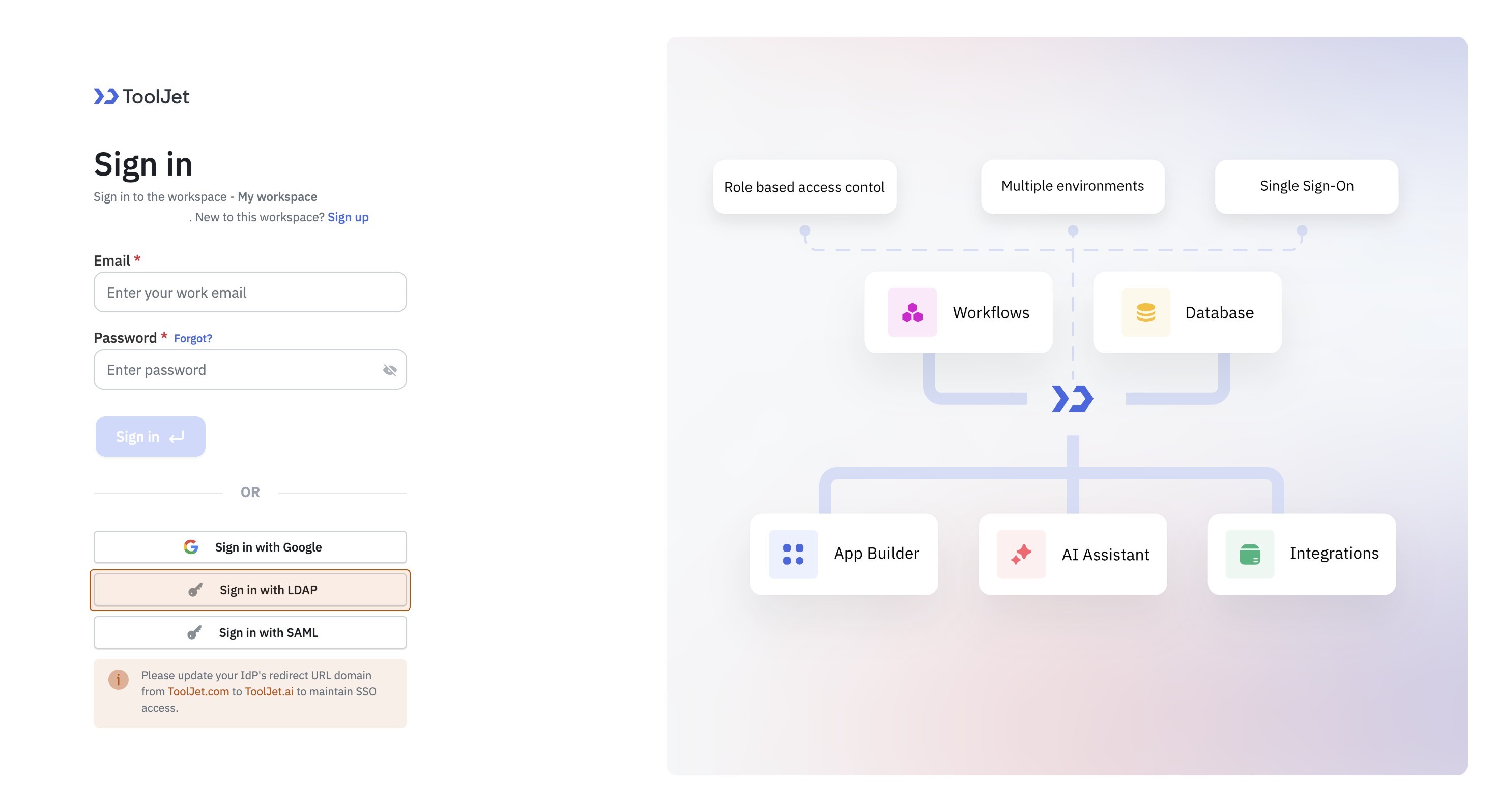
Click on the Sign in with
<LDAP Name>button, and provide your username and password to log in to the workspace. The value users enter as the Username depends on the Username attribute you selected: their common name when set to CN, or their full User Principal Name when set to UPN. Upon the initial login, users will be redirected to the Workspace Invite page, while subsequent logins will lead them directly to the ToolJet dashboard.
During the first login, ToolJet performs additional checks. It verifies the user groups in the LDAP server, and if the corresponding group exists in the ToolJet workspace, the user will be automatically added to that group. Additionally, ToolJet also looks for the user's profile picture in the LDAP server and updates the ToolJet account accordingly.
Group Synchronization
ToolJet supports syncing user groups from your LDAP directory.
- Group sync is enabled by default.
- When enabled, users are automatically added to matching ToolJet groups during login.
- Group sync can be turned off using the Enable group sync toggle in the LDAP configuration.
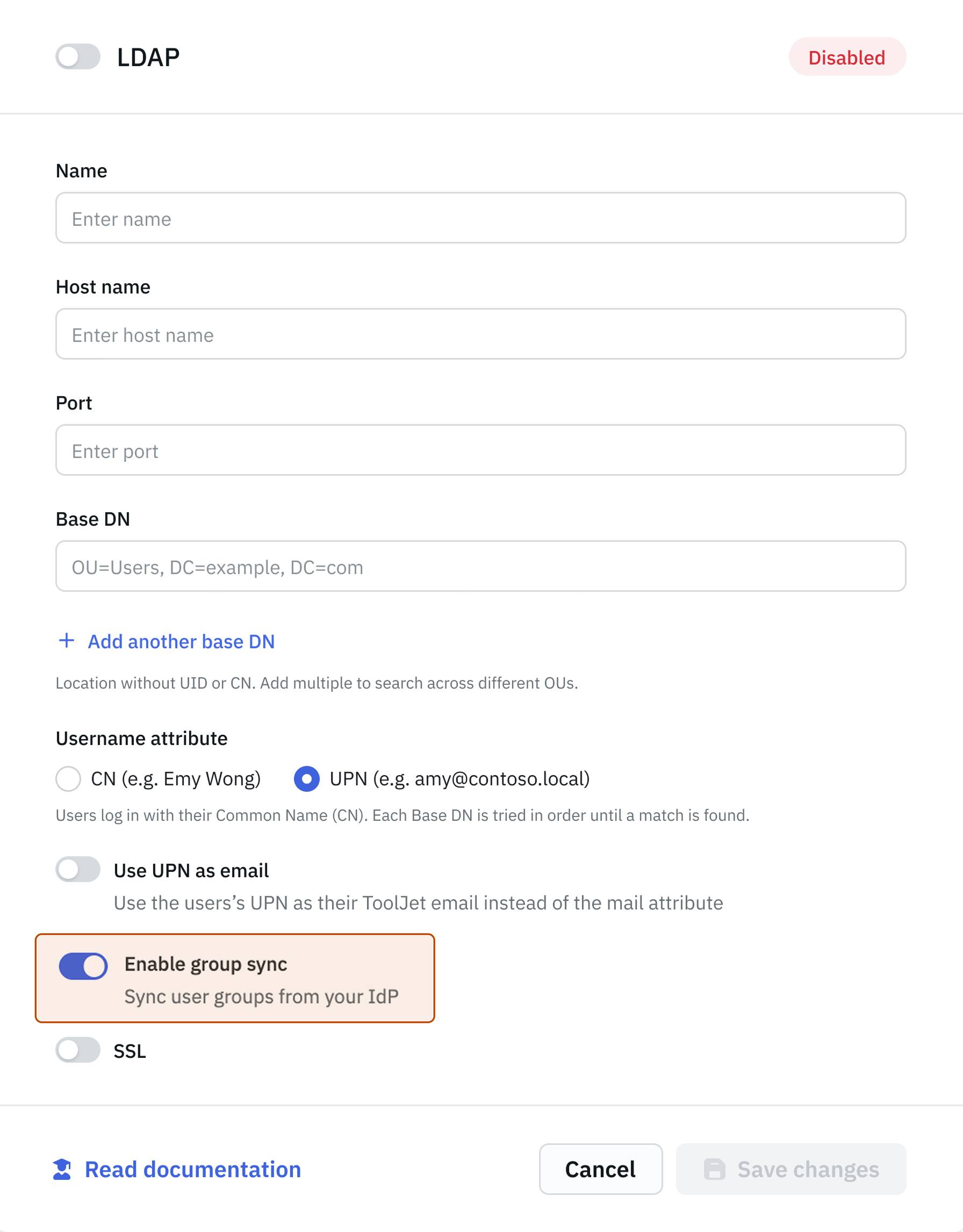
If disabled, users will still be authenticated via LDAP, but no group memberships will be synced.
Support for Multiple Organizational Units
Users often live in different Organizational Units (OUs) within the same directory. Instead of maintaining one LDAP configuration per OU, you can add several Base DNs to a single configuration.
In the LDAP configuration, click + Add another Base DN to add a row for each OU you want to include, and use the × button beside a row to remove it. Empty rows are ignored when you save.
ToolJet checks the Base DNs in the order they appear in the configuration and stops at the first match, so put the OU that holds most of your users first. If the same user name exists under more than one Base DN, the first match wins.
When the username attribute is set to CN, ToolJet signs users in as cn=<username>,<base_dn>, so each Base DN must directly contain the user entries. A Base DN that only holds child OUs will not match.
Setting Base DNs Through an Environment Variable
Base DNs can also be supplied with the TOOLJET_LDAP_BASE_DNS__<workspace_slug> environment variable, set to a JSON array. Replace every hyphen in the workspace slug with an underscore, so the workspace nexus-corps becomes TOOLJET_LDAP_BASE_DNS__nexus_corps.
TOOLJET_LDAP_BASE_DNS__nexus_corps='["ou=team1,dc=company,dc=com","ou=team2,dc=company,dc=com"]'
Configuring Base DNs in the UI is the recommended approach. Use this variable only if you already rely on it, and restart the ToolJet server after changing it.
When this variable is set, it takes precedence and the Base DNs entered in the LDAP configuration are ignored. If the value is not a valid JSON array string, login fails and the server logs Invalid TOOLJET_LDAP_BASE_DNS format. Must be a JSON array string.
Username Attribute
The Username attribute setting decides what users type into the Username field, and how ToolJet authenticates them.
CN
Users sign in with their common name, for example Amy Wong. This is the default and suits directories where users are organized under predictable containers.
UPN
Users sign in with their full User Principal Name, for example [email protected]. This suits Active Directory deployments where people already know their UPN and it doubles as their email address.
UPN sign-in works out of the box with Active Directory. Directories that require a full distinguished name to authenticate, such as OpenLDAP, must allow anonymous search on the configured Base DNs, because ToolJet looks the user up before signing them in. If yours does not, use CN instead.
Email Resolution
ToolJet needs an email address to create or match the ToolJet account for an LDAP user.
By default, ToolJet reads the mail attribute and uses the first value if it holds several. If mail is empty, ToolJet falls back to the userPrincipalName attribute, provided its value is a valid email address. This fallback exists because Windows Active Directory often leaves mail empty while the UPN holds the user's actual email address.
When the username attribute is set to UPN, you can turn on Use UPN as email to reverse this order and use the UPN as the ToolJet email instead of the mail attribute, provided the UPN is a valid email address. If it is not, ToolJet uses mail as usual. This is useful when mail holds an alias that differs from the address you want people to have in ToolJet.
If no valid email address can be determined, the user cannot sign in. To resolve this, populate either mail or userPrincipalName for that user in your directory.
Need Help?
- Reach out via our Slack Community
- Or email us at [email protected]
- Found a bug? Please report it via GitHub Issues