App Generation
ToolJet AI generates an application from a description: it plans the application, builds it on the canvas with its data and queries, and checks that it works. The build is shown stage by stage in the AI chat. The AI asks a question when it needs a decision, and each change can be reviewed or undone afterwards.
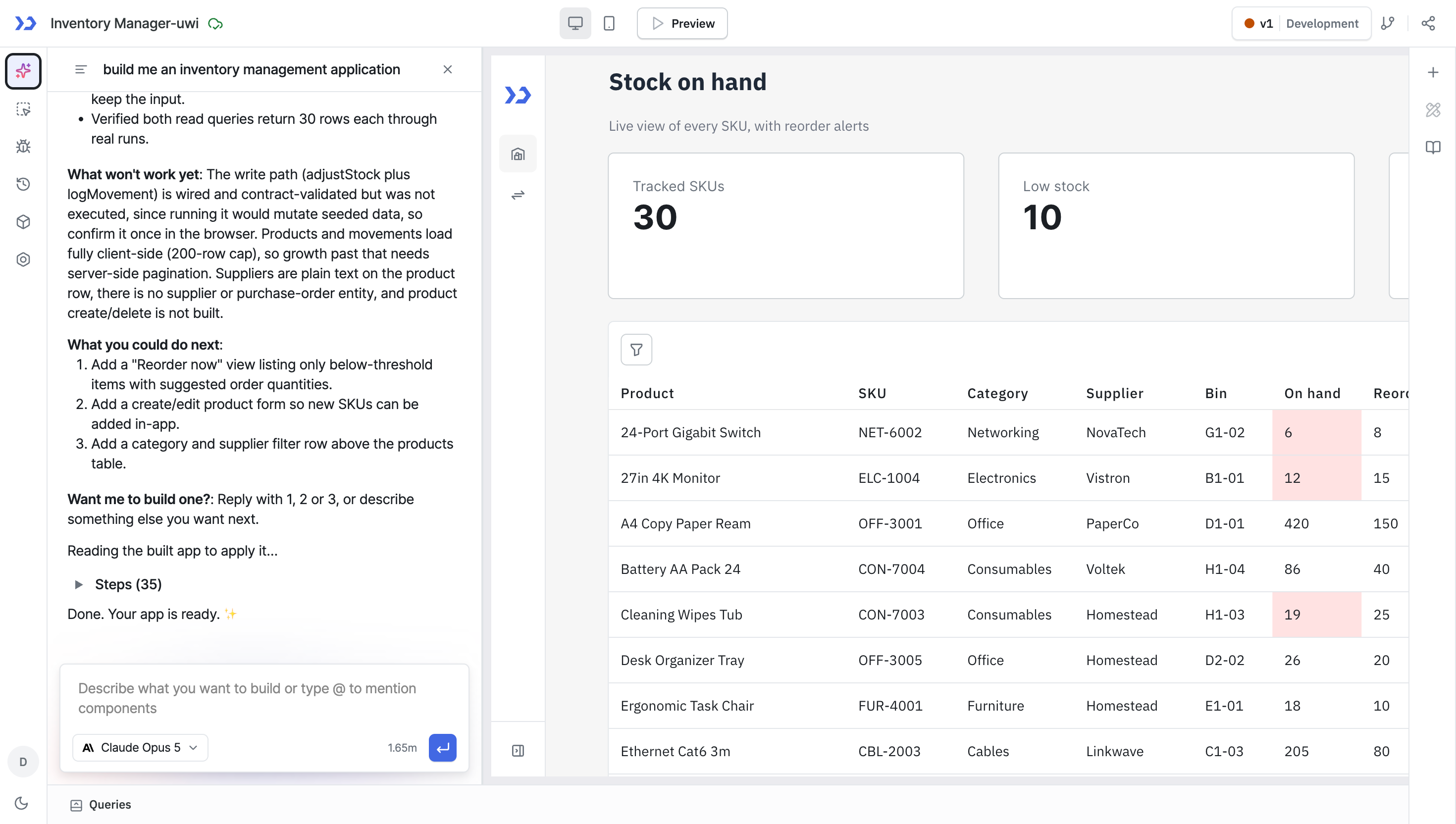
This page covers Start with a prompt, the AI built into ToolJet. To build the same apps from Claude Code, Codex, or another coding agent, see ToolJet MCP instead.
Creating an Application
Creating an application from a prompt has five steps. The steps are the same for visual applications and React Builder applications.
Describing the App
- Open the Home page, or click Start with a prompt on the apps dashboard.
- Describe the business application. To build on an existing datasource, type
@and mention a datasource. Up to 5 files can also be attached. - Click the build button.
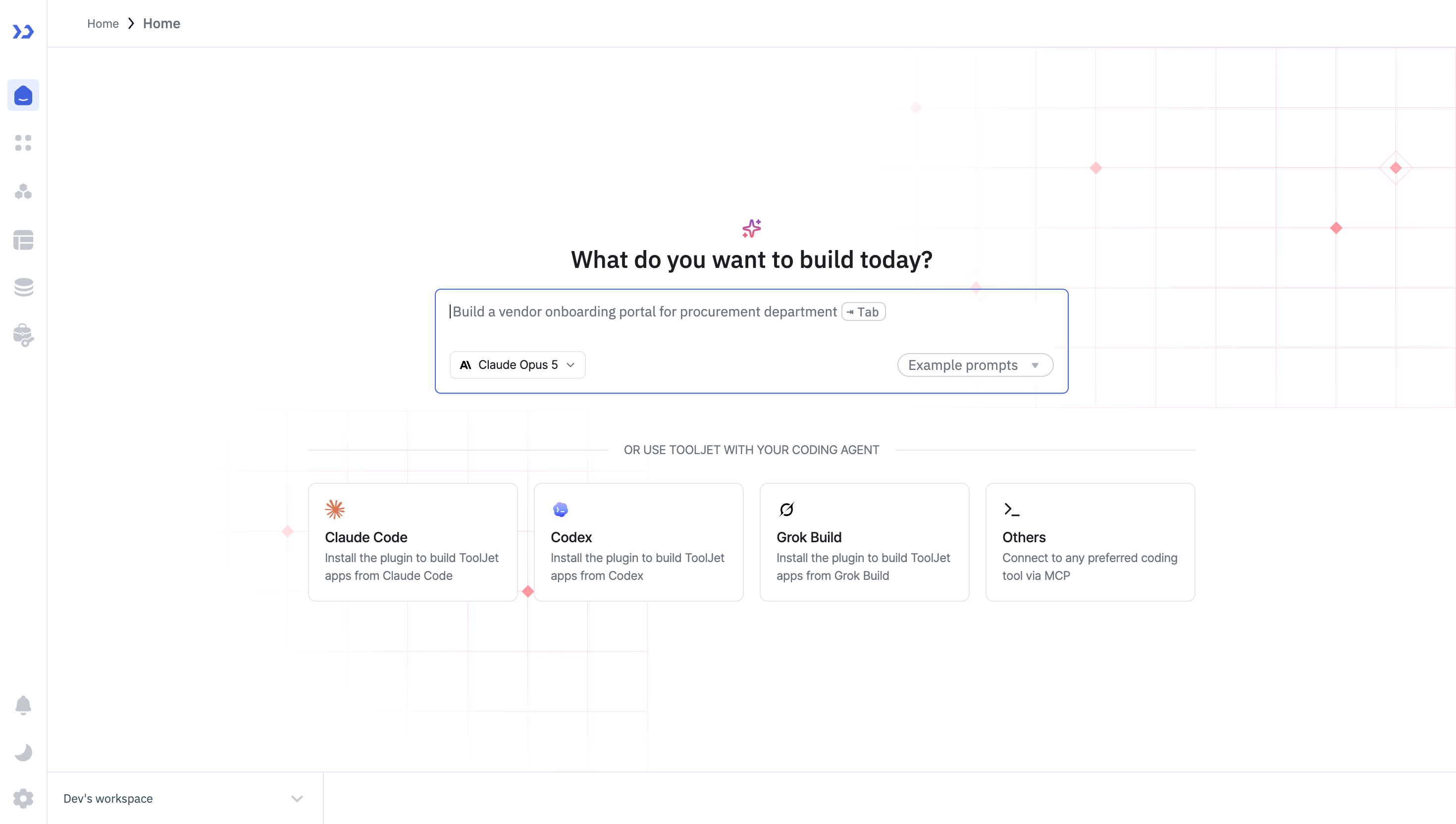
ToolJet creates the app, opens it in the App Builder and sends the prompt as the first message in the AI chat.
Choosing How the App Is Built
When a prompt for a new app is sent, ToolJet asks how it should build the app. Click a card, and the build starts.
- Visual builds the app from components on a drag-and-drop canvas, suited to most internal tools. See the Visual Builder overview.
- React Builder writes the app as React code that can be edited in ToolJet or in a local code editor. See the React Builder overview.
ToolJet keeps asking for each new app until Don't ask again is selected. After the first choice, the prompt box also shows the build mode it will use, and the mode can be switched there. An app keeps the mode it was created in.
Answering Questions During a Build
When the prompt leaves a decision open, the build pauses and a question appears above the message box. Nothing changes on the canvas until the question is answered.
- Select one of the numbered options. The option the AI recommends is already selected.
- Click Continue. To let the AI decide instead, click Skip.
To answer in free text, select Something else and type the reply in the message box.
Watching the Build
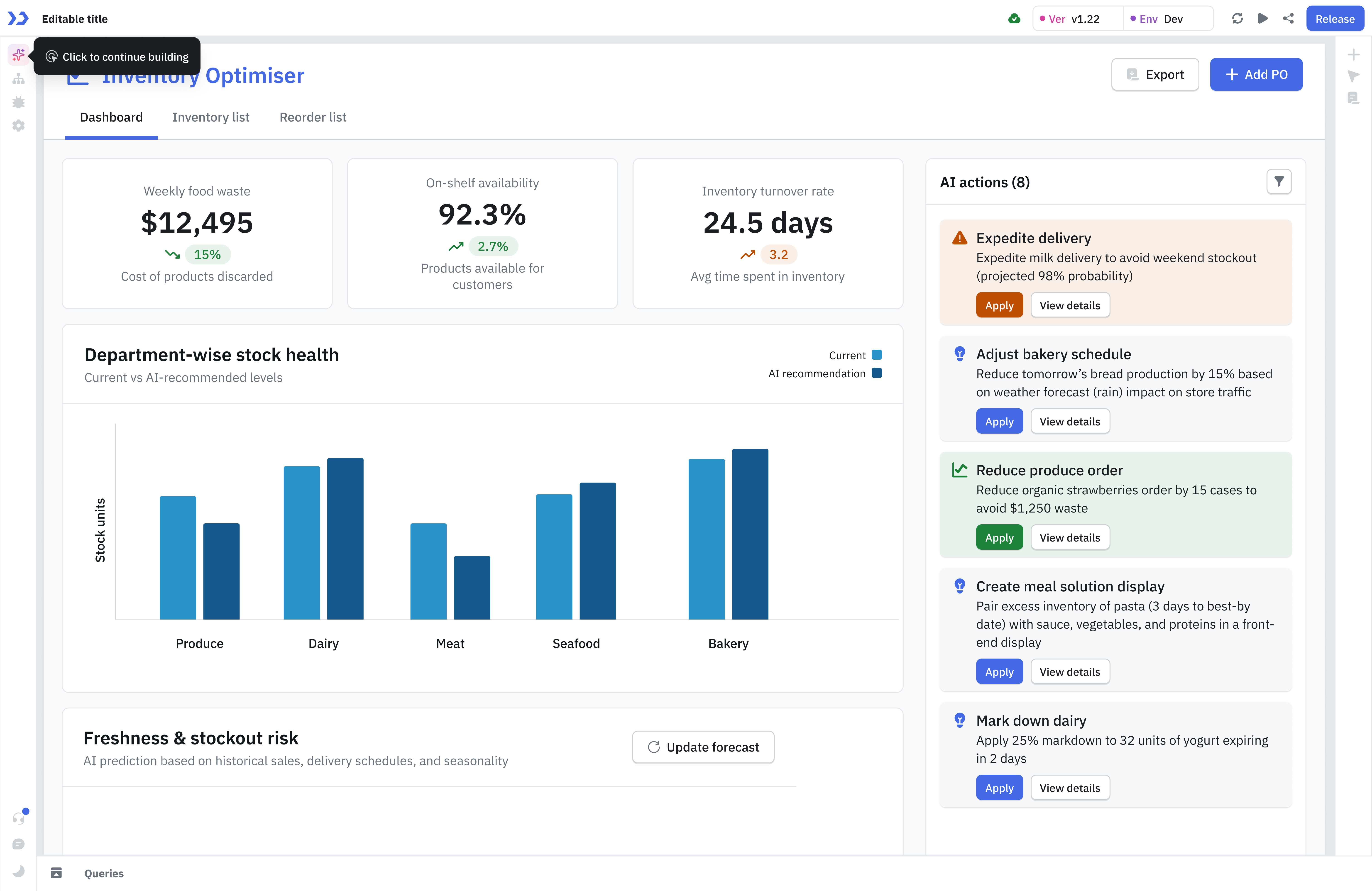
The chat shows the build's stage, a running clock and the step it's working on. A new app is built in three stages: Data, where the AI reads the app's data, then Build, then Check, where it checks that everything works.
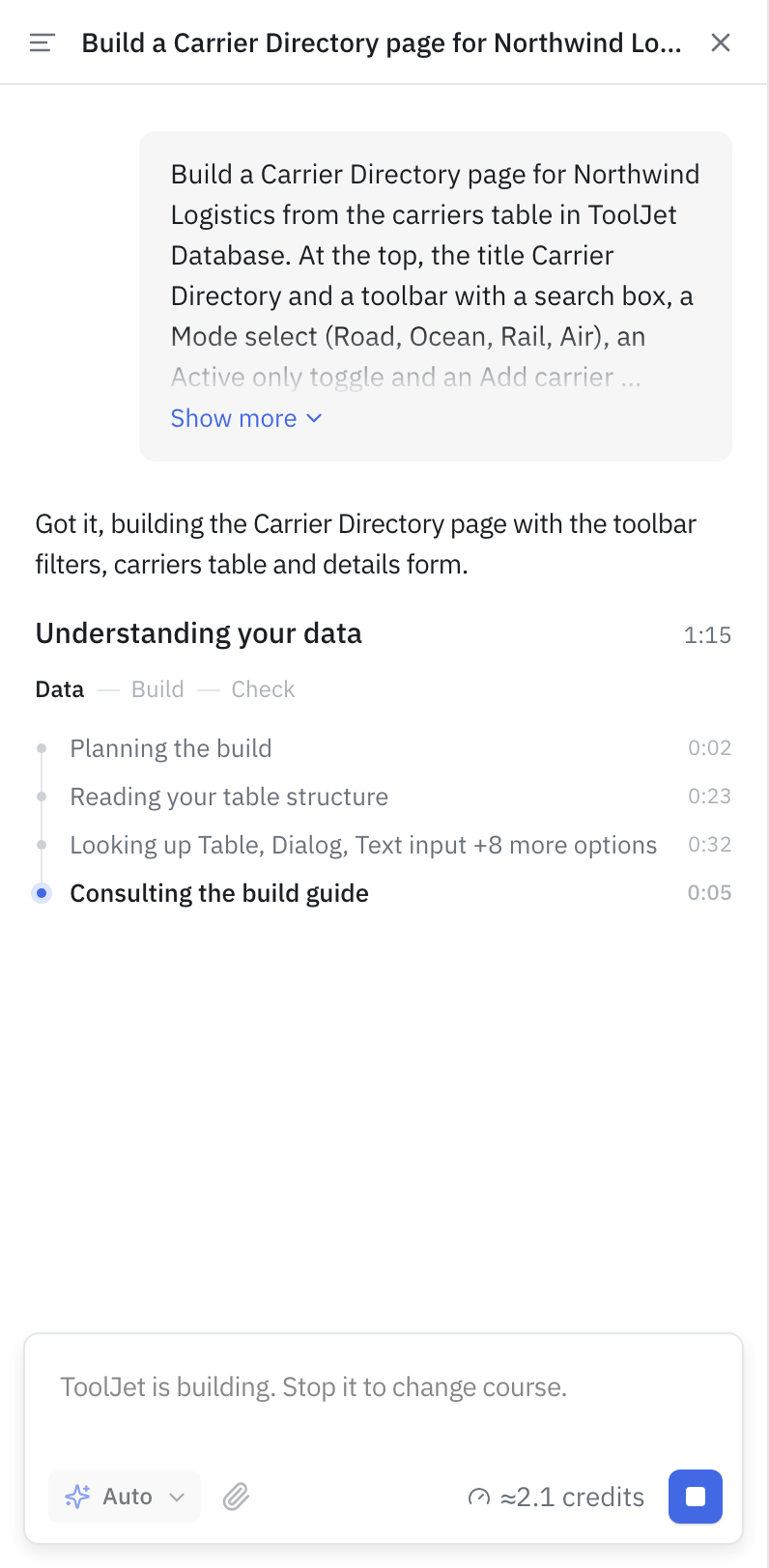
On the canvas, a visual app fills in as each change lands. A React Builder app's screens appear once their code is built, near the end of the build.
The build keeps going if the page is reloaded or another chat is opened. To change course, click the stop button that replaces the send button. To get a notification when the build is done, click Allow notifications when the chat offers it.
Reading the Summary
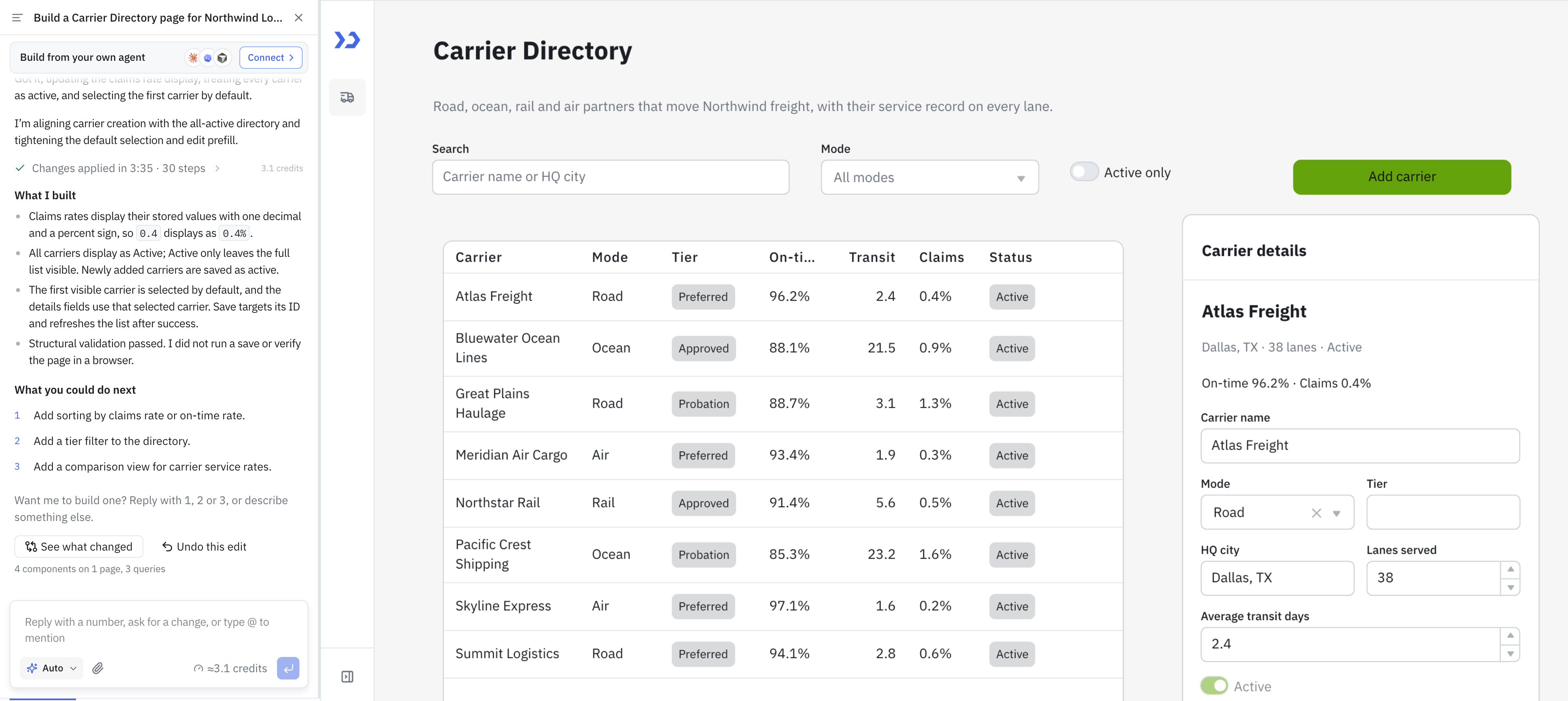
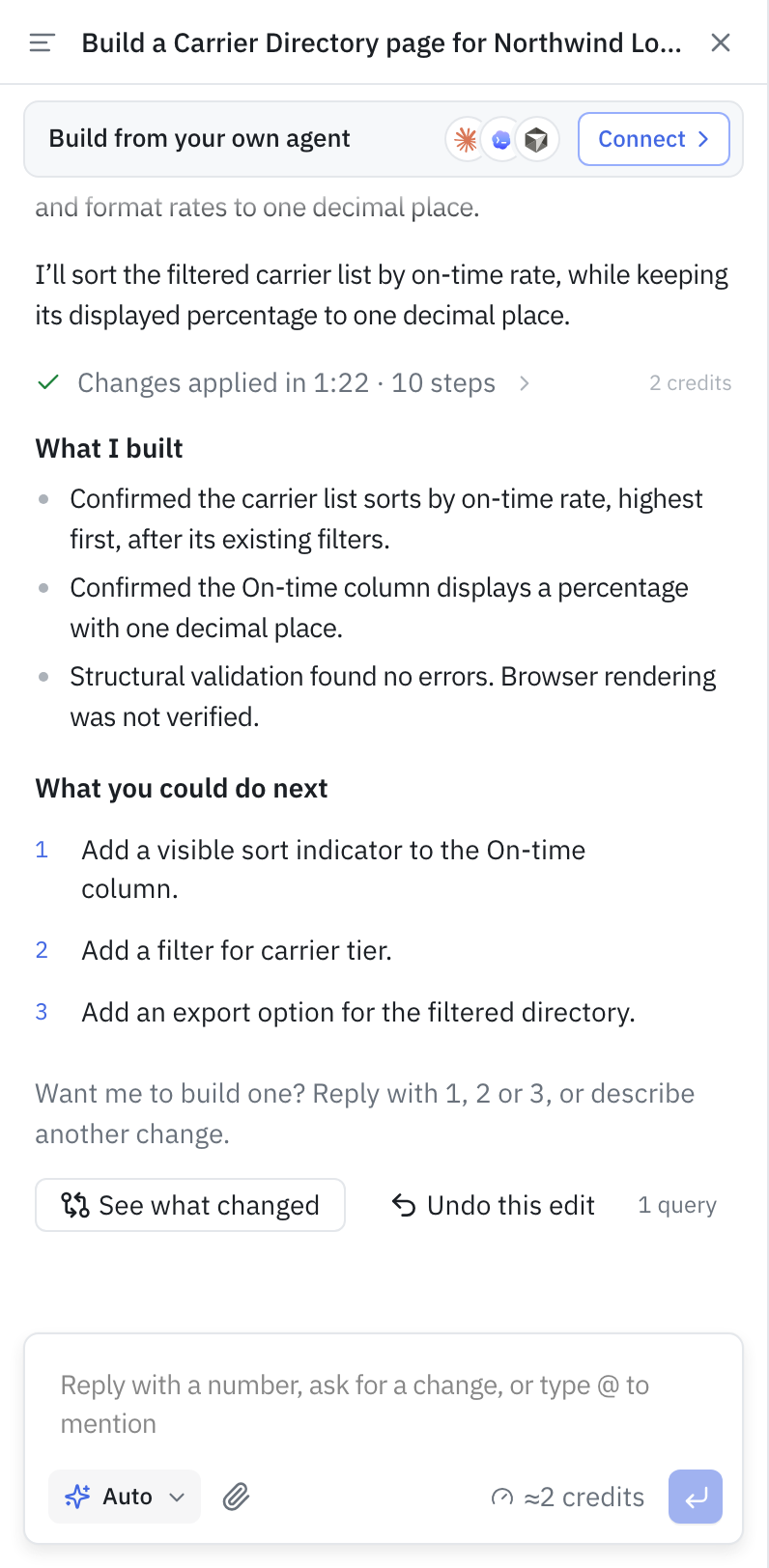
When the build finishes, the chat shows how long it took, how many steps it ran and, with ToolJet Managed AI, the credits it used. Click that line to see every step.
Below it, the AI lists what it built and suggests next steps. Click a suggestion, and the AI starts on it. The app is now ready to use, or to change by hand or with another prompt.
Modifying an Application
ToolJet AI can change any app, whether the AI built it or not. Open AI chat in the left sidebar and describe the change. To change one specific component or query, @mention it in the chat.
An edit shows two stages, Build and Check. While it runs, a visual app's canvas can't be clicked. A React Builder app's canvas stays live.
Reviewing and Undoing an AI Edit
Pro PlanAfter an edit, click See what changed under the AI's reply to compare the app before and after it. It opens the same view as Compare Versions.
- In a visual app, Undo this edit beside it reverses the newest edit. Both buttons appear on edits after the first build, which has nothing to compare with.
- In a React Builder app, the comparison has three views: Screens, Code and Access. Undo this edit is inside the comparison, and Redo brings the edit back.
Creating Modules
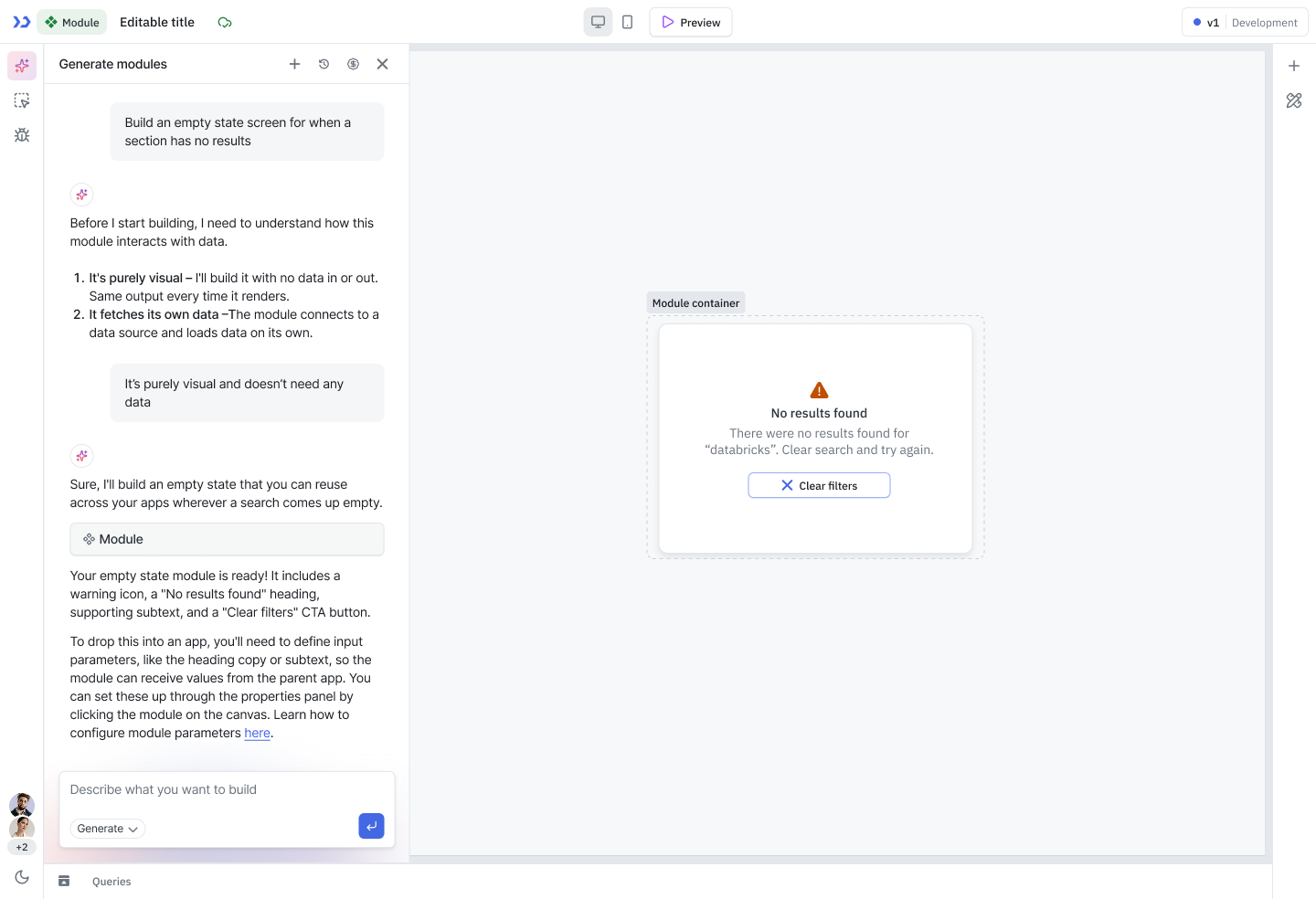
ToolJet AI also generates modules, which can be reused across multiple applications. Describe the UI in the prompt box on the Modules dashboard, or in the AI chat of the Module Builder.
Chat History
Each app keeps its AI chats, and each chat is private to the user who started it. To reopen one, click the Chats icon in the AI chat header. See Chat History for more.
Other pauses, phases and problems
Other Cards That Pause a Build
Besides a question, the AI can pause a build and wait for one of these actions:
- Pick a datasource. The card asks to Select data source(s) for the app's data. If the prompt @mentioned datasources, only those are offered.
- Connect a data source. If the app needs a data source that isn't connected yet, click Connect followed by the data source name to set up the connection without leaving the chat, then click I've connected followed by the name to continue the build. The AI can also be told to use another datasource or sample data. On self-hosted deployments, a marketplace plugin that isn't installed shows Install instead, which opens the Marketplace in a new tab.
- Review the specs. See Reviewing the Specs.
Reviewing the Specs
Pro PlanWhen the AI writes a specification for the app, the chat shows a Specs card. Click it to open the document next to the chat. Each time the specification changes, ToolJet keeps the earlier version. Use the version dropdown (Version 1, Version 2 - latest, and so on) to switch between them.
To edit the latest version, click Edit, make the changes, then click Save & continue. The AI reads the changes and updates the specification. Click Cancel to discard the changes.
Implementation Phases
Pro PlanFor a larger app, the AI can split the build into phases. A panel above the message box lists the implementation phases and how many steps of each are done, for example 2 of 5. When a phase is done, click Next phase to build the next one, or click Start on a later phase to build that one.
If a Build Stops or Fails
- If the build was stopped, click Continue the build to carry on.
- If the build failed or was interrupted, what it saved before then is kept. Click Retry to run the same request again, or pick another model first.
- If a mentioned datasource can't connect, the prompt isn't sent. Fix the connection or remove the mention, then send it again.
More About Undo
- An undone edit stays in the app's history, so it can be brought back later.
- A saved, promoted or released version is locked. Undo the edit in a new draft.
- If the version changed after the edit, undoing it would lose that work. Restore an earlier point from App History instead.
Keyboard Shortcuts
- In a question, press an option's number to select it and Enter to send it.
- In the prompt box on the Home page, press Cmd/Ctrl + Enter to start the build.